Fine Cooking Pan-Roasted Brussels Sprouts with Shallots and Rosemary

Brussels sprouts excite me! I love that for so much of my life, I avoided them like the plague. Their gross, gassy smell, their spongy, soggy texture, their bland flavor…blech! There are few things I wouldn’t eat, but brussels sprouts were on that short list. Were on that list. Now they top my list of favorite foods. And I love that! I love that even as a forty-something woman, I can still change my mind, still discover new things to love, still discover I don’t hate the things I thought I once did. What else will change about me? The things I think I know about myself today will change in the future, and I am reminded of this fact every time I am enjoying brussels sprouts. What can get more exciting than that?

The very first brussels sprouts recipe which won my heart was this one, first published in the November 2002 Bon Appetit, Brussels Sprouts with Pearl Onions in Horseradish Cream. I have made this and recommended this often, always to rave reviews. I was considering that recipe for Thanksgiving, but then I came across this one from the September 2011 Fine Cooking, Pan-Roasted Brussels Sprouts with Shallots and Rosemary.

I made this last night, and it was phenomenal! I mean, what couldn’t be phenomenal if covered in enough cheese and cream and bread crumbs and butter? Even if you are not a big brussels sprouts fan, I hope you will try this. I have a feeling this could win over even the most reluctant brussels sprout eater.

Pan-Roasted Brussels Sprouts with Shallots and Rosemary by Juli Roberts

Ingredients

1-1/2 lb. Brussels sprouts, trimmed
2 large shallots, halved
4 Tbs. unsalted butter
Kosher salt and freshly ground black pepper
1-1/4 cups heavy cream
3-1/4 oz. (1-1/4 cups) finely grated Gruyère
1/4 tsp. freshly grated nutmeg
1/8 tsp. cayenne
3/4 cup panko
1/2 cup finely grated Parmigiano-Reggiano
2 tsp. finely chopped fresh rosemary

Directions:

Position a rack in the center of the oven and heat the oven to 375°F. In a food processor fitted with the slicing blade, slice the Brussels sprouts and shallots.
In a 12-inch oven-safe skillet, melt the butter over medium heat. Continue to cook the butter until it begins to brown and smell nutty. Set aside 1 Tbs. of the browned butter in a medium bowl.

Add the Brussels sprouts, shallots, 2 tsp. salt, and 1/2 tsp. pepper to the pan and toss to combine. Cook, stirring occasionally, until the Brussels sprouts and shallots begin to soften and brown in spots, about 6 minutes. Remove the pan from the heat.

Meanwhile, in a 2-quart saucepan over medium heat, combine the cream, Gruyère, nutmeg, cayenne, and 1/4 tsp. salt. Heat until the cheese is melted, whisking occasionally, about 4 minutes. Do not boil. Add the sauce to the Brussels sprouts, carefully stirring to combine.

Add the panko, Parmigiano, rosemary, and a pinch of salt to the reserved butter and mix thoroughly. Top the sprout mixture with the panko mixture.

Bake until the crumbs are browned and the Brussels sprouts are tender, 10 to 15 minutes. Let cool for about 5 minutes before serving.

Serves 6 to 8

This is what the brussels sprouts and shallots look like after six minutes in the pan.

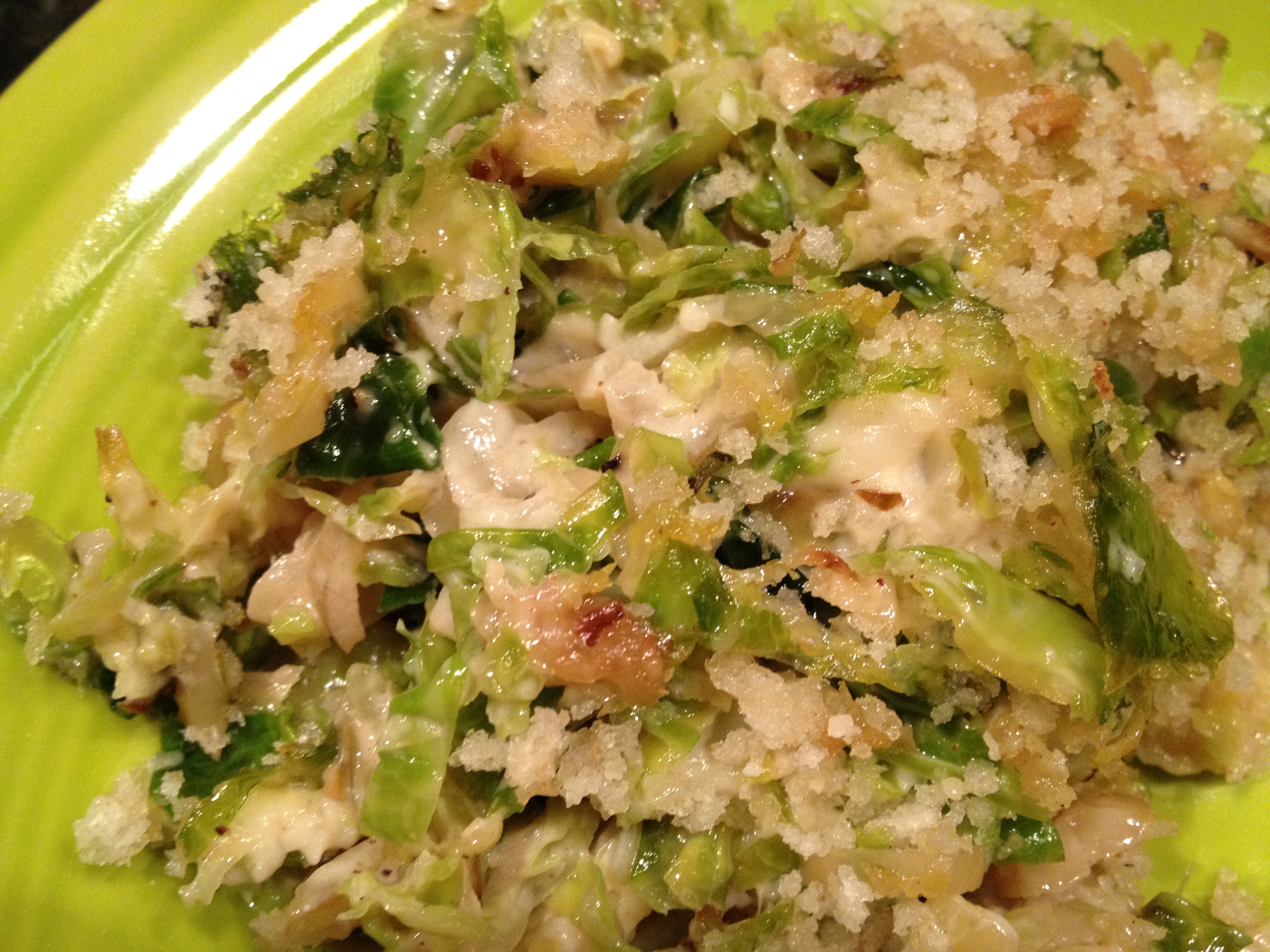
On the plate and ready to convert more haters to lovers!

Ask Mom Mom: So You’re Hosting Thanksgiving

This week, Mom Mom was asked a question in person. All the more fun!

I ran into a friend at school the other day, and she shared that she was hosting her first big Thanksgiving for about twenty people and could use some advice/hand holding/Xanax. Like most people would be, she was a little anxious about…well, about the whole production of it all. Thanksgiving is not for sissies. Most people forgive and forget a bad meal on any given Tuesday, but Thanksgiving? That one stays with you. However, with a little planning and preparation, this can be one of your greatest victories.

Luck favors the prepared, darling. — Edna Mode, The Incredibles

Step 1: Menu Plan

This may seem obvious to some, but I am sure others are saying, “Turkey, stuffing, what plan?” NOW is the time to sit down with your food magazines or your DVRd Food Network shows or Google and DECIDE EXACTLY what will be going on your table.

Part A of this plan is deciding what category of food you want, and Part B is deciding which recipes you will use or which relatives you will ask to contribute. If I were hosting 20 people, my plan would look like this:

Light Appetizer (nothing to upstage my hard work)

Bread/Rolls

1 standard green vegetable

1 adventurous green vegetable

Corn

1 stuffing with sausage

1 vegetarian stuffing

Cranberry sauce

1 mashed potato dish

1 sweet potato dish

Turkey

2 pies

2 other desserts

Wine, Beer

Soft drinks

Coffee/tea

Once you’ve gotten all your food listed, it’s simply a matter of choosing your recipes. Remember, no need to be a martyr! If (and only if) your guests have offered to contribute, you can certainly shorten your list by delegating. Desserts are a good one to farm out. And if a trusted guest/cook can help you knock a potato off the list, all the better! Feel free to ask any questions in the comments, and I promise I will try my best to guide you.

Do the bulk of your shopping for non perishables the Friday or Saturday before Thanksgiving, and the earlier in the morning the better. Each passing hour, things get exponentially more crazy. But as bad as it will be on those two days, it will only get worse, so refer to your shopping list and knock out every single item you possibly can (soda, beer, wine, cheese, etc.) I am a huge fan of off-hours shopping, so shopping really early or really late helps preserve my sanity. Save your fresh vegetables and any other last minute items for the Tuesday before Thanksgiving. In a perfect world, you will have very little left on your list by that point.

Step 2: Logistics

This is a boring and often overlooked step, but let me assure you that it’s every bit as important. Make sure each one of your guests has a place to sit down and a proper place setting. It doesn’t have to be fine china, crystal or silver — warehouse clubs like BJs and Costco have nice quality disposables that are neutral enough to blend with your good stuff. If at all possible, give each guest a seat on a real chair and a real table rather than a sofa and coffee table. Sure, it’s fine to put your grandmother and the real dining room table and your eight year old at the fold-up card table, but to have some guests sit at a real table and others jockey for space on the sofa seems rude and unfair. Take the time to map out where people will be sitting, and if there is not obvious space available for everyone, tell them ahead of time where you expect them to eat. There is nothing worse than people with full plates in hand nomadically shuffling from room to room looking for an open spot to sit down. Everyone deserves a spot, and it’s your job to make sure they have one.

Step 3: Turkey, fresh or frozen?

This is a matter of personal preference. I have done both, and believe it or not, fresh has never come out significantly better. People are passionate on this subject, and I’m sorry, but I can’t take a firm stand based on taste. Obviously a humanely-raised-locally farmed-Montessori-educated-vegan-fed turkey is better for variety of reasons, most of which allow you to feel morally superior, but from a culinary standpoint? Eh, not so much in my book. Preparation is everything.

And by preparation, here is your reminder to order your fresh turkey N O W, especially if you require something in the neighborhood of 20 pounds or more. Don’t expect to waltz into the supermarket the Monday before Thanksgiving and pick up your 20+ pound turkey. It will be known as The Year You Made Two Twelve Pound Turkeys if you don’t plan ahead. There are a variety of turkey calculators online. Use them! You will be able to plug in your specifics and plan accordingly. For example, 15 adults and 5 kids who are big eaters would require a 26 pound turkey. If that turkey is frozen, it will take six and a half days to thaw in the refrigerator. Needless to say, these are not details you can just work out three days before Thanksgiving. Spend a few minutes today thinking about this.

Step 4: The Set Up

Start cleaning your house (or have someone else clean it for you) the Tuesday before Thanksgiving, and leave the minor last minute touch up for Wednesday and Thursday. Wednesday night, set the table(s), move furniture to accommodate more tables, inspect/dust folding chairs, make sure table cloths are clean and fit. Inspect your china/crystal/silver and make sure it is clean and polished (or at least clean and sanitary). This always takes more time than you think it will, so do it the night before and save yourself some stress. I have been that person in cashmere and pearls cleaning a toilet while the first guest rang the doorbell. Learn from my mistakes.

Step 5: Food Prep

Bright and early Thursday morning, I like to go through each recipe and measure and chop ingredients ahead of time. It’s so much easier to make a stuffing with fourteen ingredients when they’ve all been prepped and measured and put into neat little baggies.

This is also the time where you fine tune your game plan and assign oven space. Before I got a double oven (and even some years after) I would use the oven of my neighbor across the street who would always travel during Thanksgiving. Most friendly neighbors are happy to lend you their ovens or refrigerators if they’re away, so that’s an option to consider. If not, you just have to work it out. It’s like a bad math problem: Sally has a turkey in the oven at 325 for five hours and it has to rest for 30 minutes. Once the turkey is out she has two dishes to cook, one at 375 for 30 minutes and one at 350 for 40 minutes...

The time to solve this sixth grade word problem is not when your guests have arrived and you’re drinking wine. Make your schedule with a sharp mind and a clear head, and stick to it accordingly.

Step 6: Enjoy your guests, enjoy your blessings

Take time to enjoy the day. Some of my best memories are of having Mom Mom and Pop Pop in my house for Thanksgiving. They were so happy and proud of all my hard work and enjoying their kids, grandkids and great-grandkids surrounding them. Watching the cousins play, seeing family from near and far, even if it’s just that one day a year, is so important. It’s a great honor to provide a venue for your family to gather, enjoy good food, and count their blessings. It is a big job, yes, but it is always worth the effort. Be thankful you are up to the challenge.
Fine Cooking German Chocolate Cake

This summer Ed got us a subscription to Fine Cooking Magazine. He bought the June issue on a whim and liked it so much he decided to subscribe. I am sure he had the best of intentions. Now, I realize subscribing to a cooking magazine without consulting your spouse is not like buying a car without consulting your spouse, but it felt like a big deal to me. I take my food magazines very seriously, and I’m really only loyal to two: Cook’s Illustrated and Bon Appétit. Inviting another magazine into our home is serious business. I just didn’t know about this and needed some time to adjust. Part of it, too, is the name. Fine Cooking? Seems a little pretentious, no? It reminded me of the SpongeBob episode featuring “Fancy Living Digest.” In fact, I’ve taken to calling it “Fancy Cooking” in my head.

But like all change, I warmed up to it after a few months. Sure, the lasagne recipe is six pages long, and recipes like that will always annoy me, but you can’t be all things to all people. It almost seems like a cross between Cook’s Illustrated and Bon Appétit, both cerebral and high quality, so as usual, Ed was on the right track. Once I stopped being mad at the magazine and started to actually read it, I found quite a few intriguing recipes I look forward to trying.

Yesterday I made their German Chocolate Cake featured in the December 2011/January 2012 issue. First things first, this cake was 100% WORTH THE EFFORT. If you like German Chocolate Cake, I highly encourage you to try this one. In fact, I dub this The Best German Chocolate Cake I’ve Ever Eaten. I consider myself a solid but not advanced baker, so this was definitely one of the fussier and more elaborate cakes I’ve ever made, but I don’t think any advanced skills are required as long as you are patient, read the recipe thoroughly and follow directions carefully. I have documented my pictures and notes below the recipe.

German Chocolate Cake by Alice Medrich, Fine Cooking Dec 2011/Jan 2012

For the cakes
4 oz. (1/2 cup) unsalted butter, softened; more for the pans
4 oz. semisweet or bittersweet chocolate (up to 70% cacao), coarsely chopped (about 1 cup)
1/2 cup boiling water
9 oz. (2 cups) unbleached all-purpose flour
1 tsp. baking soda
1/2 tsp. table salt
4 large eggs, at room temperature
2 cups granulated sugar
1 tsp. pure vanilla extract
1 cup buttermilk, at room temperature

For the coconut-pecan filling
7 oz. (about 2 cups) sweetened, shredded dried coconut
4 large egg yolks
1 12-oz. can evaporated milk
1-1/2 cups granulated sugar
2 tsp. pure vanilla extract
3/4 tsp. table salt
6 oz. (3/4 cup) unsalted butter, cut into chunks
1-1/2 cups pecan halves, toasted and coarsely chopped

Make the cakes

Position racks in the upper and lower thirds of the oven and heat the oven to 350°F. Grease the sides of three 9×2-inch round cake pans with butter and line the bottoms with parchment circles.

Put the chocolate in a small bowl and pour the boiling water over it. Let stand for several seconds and then whisk until the chocolate is dissolved. Set aside until cool to the touch before mixing the batter.

Sift the flour, baking soda, and salt onto a sheet of waxed paper. Whisk the eggs in a small measuring cup.

Beat the butter for a few seconds in a stand mixer fitted with the paddle attachment on medium-low speed. Add the sugar in a steady stream and then beat on medium speed, scraping the bowl as necessary, until the mixture is lightened in color and fluffy, 4 to 5 minutes. Still on medium speed, add the eggs a little at a time, taking a full 1-1/2 minutes to add them all. Add the melted chocolate and vanilla and beat just until blended. With the mixer turned off, add a quarter of the flour mixture. Mix on medium-low speed just until incorporated. Add a third of the buttermilk and mix until blended. Repeat, each time adding another quarter of the flour, then a third of the buttermilk, until the last of the flour is added. Scrape the bowl as necessary and mix each addition only until it is incorporated.

Divide the batter among the pans and spread it evenly. Bake, rotating the pans and swapping their positions, until the cakes just start to pull away from the sides of the pans and spring back when very gently pressed with a finger, 20 to 25 minutes. Let the cakes cool in their pans on a rack for 10 minutes.

Run a knife or small spatula around the edges to separate the cakes from the pans. Turn the cakes out onto the rack and peel off the parchment. Cool completely.

Make the filling
Spread the coconut on a rimmed baking sheet. Bake at 350°F, stirring every 2 minutes, until golden-brown, about 10 minutes. Scrape the toasted coconut onto a sheet of waxed paper and let cool completely.Whisk the egg yolks with the evaporated milk, sugar, vanilla, and salt in a heavy-duty, nonreactive 4-quart saucepan. Add the butter. Set over medium heat and stir constantly with a heatproof spatula, scraping the bottom and corners of the pot. When the mixture starts to boil, adjust the heat so that it boils actively but not furiously, and cook, stirring constantly, until golden and thickened, 3 to 4 minutes. Off the heat, stir in the coconut and pecans. Let cool completely.

Assemble the Cake

Put one cake layer on a cake plate. Spread a third of the filling over the top of the cake, leaving a 1/4-inch border. Top with a second cake layer. Spread with half of the remaining filling. Put the third cake layer on top and cover it with the remaining filling. Leave the sides of the cake exposed. Serve at room temperature.

Sifting the flour onto a piece of waxed paper was my first hint this cake might be a little high maintenance, and it’s when the carpal tunnel first started to kick in. Do not skip this step!

It’s really important to get the right level of heat and constant whisking for the filling so it is the perfect consistency. If your wrist didn’t hurt you before, it will now!

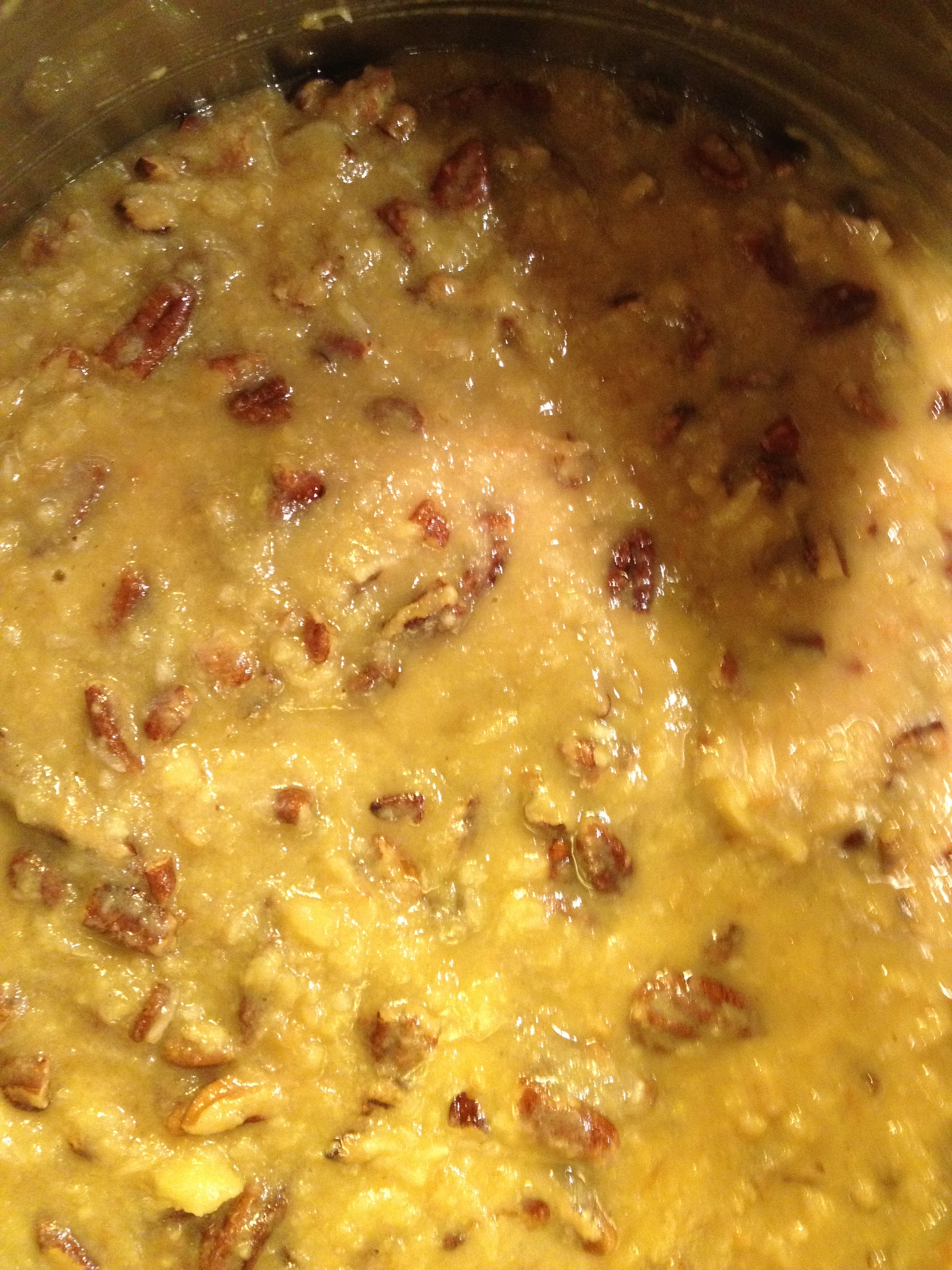
Add the toasted coconut and toasted pecans and let cool and thicken. It may not look pretty, but this is the most delicious filling I have ever eaten.

While this cake didn’t turn out cover-model beautiful, it was perfect in every other way.

p.s. Ask Mom Mom is taking a break this week. Is it because someone can’t find her old-school notebook with this week’s column in it? I’ll never tell.

p.p.s. Sorry to my subscribers for the flukey phantom Cake2 post earlier. I am still playing around with my new phone and attempted to upload a photo to WordPress, and I didn’t mean to publish anything. Oops!

November Gratitude: Mom Mom’s Fur

Mom Mom had a sense of style that is hard to adequately describe, but some words which come to mind are: sparkle, glitter, razzmatazz, festive and loud. She was about as subtle as one of Trump’s casinos, and usually favored the same color palette. Naturally, animal prints were a lifelong wardrobe staple season after season, leopard being a favorite choice, whether in a bathing suit or a fur coat. Mom Mom didn’t need Kim Kardashian or Rachel Zoe to tell her leopard was fabulous.

I don’t know the story of this coat, or even if it has a story, but I do remember Mom Mom wearing it, hugging her tightly and coming eye to eye with the embossed gold buttons. She didn’t wear it a lot, and it was socked away for years, but I definitely remember her wearing this.

When Mom Mom died, as her eldest granddaughter, I inherited this lovely coat. Well, it was more like, “WHO wants THIS THING?” and I jumped all over it, much to the surprise of my conservative aunt and my animal rights activist sister. I should note — before anyone mails me buckets of blood or calls me hateful names — that I love animals, too, and I would never spend money on fur (okay, maybe from a consignment store, but not brand new). If the label is to be believed, it IS real fur, but I can’t imagine actual leopards were killed. I’m thinking it must have been the fur of some poor low-brow animal who was dyed leopard, but I can’t say for sure. One of these days I will try to find out, but it really doesn’t matter to me.

For a fairly conservative dresser, I sure hit the ground running with Mom Mom’s coat. I debuted it a couple years ago at my Mad Men party, and since then it has been everywhere with me. Being a mostly stay-at-home-mom, that means the Acme and school conferences and Chick-Fil-A. The black satin lining began to rip more and more, and finally I determined it was time to replace it. I can’t say why, exactly, but I was drawn to choosing either red or emerald green for the lining this time. It just seemed like a Mom Mom kind of a choice.

I picked up the coat from the tailor yesterday, and it looks great! I am so grateful to have had a grandmother who was ahead of her time fashionwise, and whose warmth I can still feel when I’m wearing her fur. I only wish she could see me wearing it.

November: The Month of Gratitude and Organization (Gluttony Optional)

Happy November! I hereby declare this the month of Gratitude and Organization. Why, yes, I do sometimes fancy myself Oprah, why do you ask?

Thanksgiving is my absolute favorite holiday. It’s all about everything I believe in: family, gratitude and comfort food. I have hosted Thanksgiving more times than I can count (and often for no less than 20 people), but this year is a rare and admittedly welcome year off for me. We will be traveling a mere five minutes away to the home of one of my favorite hostesses, so I know Thanksgiving will be in good hands. It also means my family will be spared my Annual Thanksgiving Mental Breakdown, which usually ends with me crying, “Never again!” or “WHY do I do this to myself?” or “WHEN will I learn?” But in the end, it’s like childbirth: difficult but exhilarating, and always, always, always worth it.

I will be sharing some of my favorite Thanksgiving recipes with you this month, most of which come from the mack daddy of all Thanksgiving cooking magazine issues, the much-lauded November 1999 Bon Appétit. And I’m sure I will be trying some new stuff as well, because I can never resist an appealing Thanksgiving recipe. Send me your favorites!

In addition to recipes, I will also be sharing my journey of household organization, starting with my kitchen utensil drawers. I would love to hear if any readers have utensil drawer organizational solutions. I have two deep drawers and lots of utensils, so my first step will be throwing out or donating anything that hasn’t been used in the last two years.

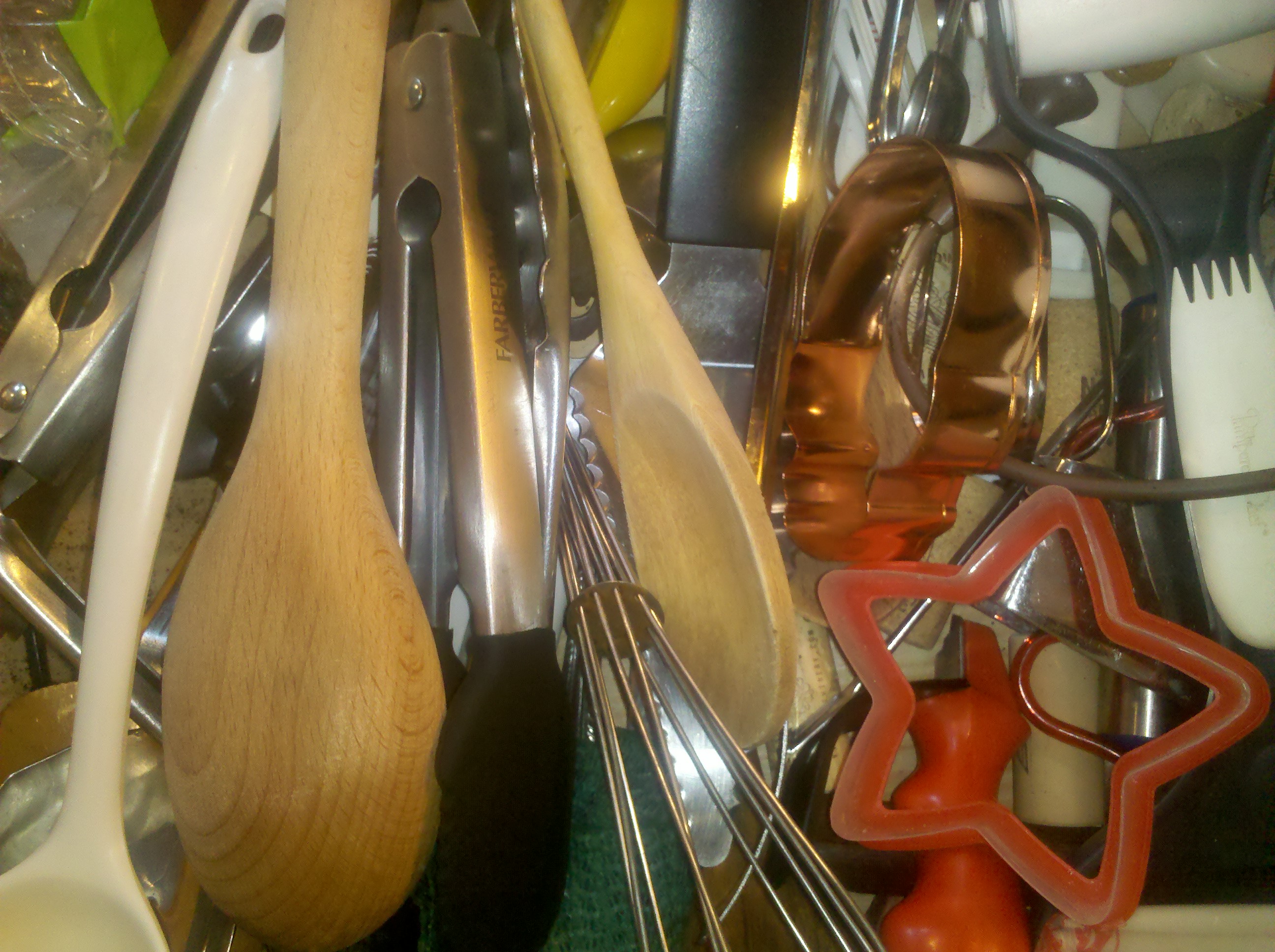
I will leave you with pictures of my two unorganized drawers, pictures which may evoke words like hoarder or mental illness, but rest assured, I am working on this today.

p.s. Note the three cat food lids. Our cat died in 2005. RIP Lulu.

Ask Mom Mom: Contagious Kids

Dear Mom Mom,

What can one do when you have two children (first grade and middle school) and you get to the highly anticipated visit to see cousin who lives 3 hours away and has the lead in her middle school musical, and during the middle of the second act it becomes apparent that the first grader you have brought three hours in the van is feverish.  He makes it through the show but has now exposed that entire side of the family to whatever virus he has.  Can’t drive home at that hour so you give him fever reducer and put him to bed in the grandparents’ house and the next morning, no fever and he looks like he had never been sick, bouncing all over the place. I left town the next morning.

The problem I am faced with is that for the next week and a half I am going to be given a run down of all the people in that side of the family that he has gotten sick.  Do I just avoid all communication with that side of the family until they aren’t playing the stupid blame game and have forgotten who brought the plague to town?  I don’t think they mean ill intent but I always feel horrible.  I never would have intentionally infected an entire city if I had known ahead of time.  But this same group of people would have been equally upset if I had known ahead of time and had canceled, because I do cancel a lot.  The trips three hours away happen only about 4-6 times a year and the kids love their cousins.

Typhoid Mary’s Mom

Dear Typhoid Mary’s Mom:

I read your email several times, and each time I was reminded of two quotes by two wise women:

No one can make you feel inferior without your consent. — Eleanor Roosevelt

Strep happens. — Mom Mom

I really can’t see how you did anything wrong. You may be a very powerful woman, but you cannot control the emergence or spreading of the world’s viruses and bacteria. Nothing in your email led me to believe you had any idea your child was sick, and once you did discover that, you left immediately. Plenty of people would have stayed if their child was feeling well the next day (hello!), but you went that extra mile in consideration. What else could have you done? Family is very important, and it’s great that you are willing to drive so far to support a cousin and promote these relationships for your kids. Your intentions are good, and you can hold your head high.

I can’t imagine anyone in their right mind would “blame” you for getting their children sick, intentionally or unintentionally, and therefore I would not avoid any phone contact or go into hiding. If anything, I would own it, saying something like, “I sure hope no one got sick from our brief visit. Fortunately it was a quick virus and our son bounced back immediately!”

Back in the playgroup days, there were two types of parents: The Crazy Bubble Parents and the normal ones. I am guessing maybe some of your relatives are the Crazy Bubble Parents? If I let our playgroup hostess know one of my kids had the sniffles or a lingering cough, the normal parents would say, “Eh, send ’em over if they’re feeling up to it! What can you do? Germs are everywhere. I might as well not go to Target if I care about germs touching me.” And the Crazy Bubble Parents would say, “Oh, I am so sorry Logan can’t come to our house. We’ll miss him at playgroup. I hope you called the doctor about that cold!”

You sound like a considerate person with good intentions who tries her best, and maybe you should explore why you are allowing these particular family members (or any people, period) make you feel bad when things turn out less than perfect. You wouldn’t want your children to feel this way, and you shouldn’t feel this way either.

Ina’s Lemon Cake

When you last left me, I had just zested 3200 lemons. Okay, it felt like that many. It was maybe more like 32. They were taking up a lot of room in my refrigerator, looking naked without their bright yellow coats, and I knew I had to use them in some capacity very soon. Look at those sad little things!

My attempt at lemon chicken was only appreciated by two out of five family members, and I was one of those two, so I will not bother to share this culinary delight with you, other than to say that ten lemons is probably six lemons too many if you’re making lemon chicken.

I was starting to feel a little resentful about the pressure to use my lemons. I did have book club last night, so I decided to make a lemon cake on a whim. I used to feel like lemon cake was one of the least appealing cakes there is, but I was wrong. Oh, I was very wrong. I should have known Ina would never forsake me.

Unless my book group was just being polite or it was the alcohol talking, people seemed to really like it. And I just polished off a very generous he-man sized piece of cake (shown below), so clearly I have changed my opinion about lemon cake. Thank you, Ina!

Ina Garten’s Lemon Cake

Ingredients

  • 1/2 pound (2 sticks) unsalted butter, at room temperature
  • 2 1/2 cups granulated sugar, divided
  • 4 extra-large eggs, at room temperature
  • 1/3 cup grated lemon zest (6 to 8 large lemons)
  • 3 cups flour
  • 1/2 teaspoon baking powder
  • 1/2 teaspoon baking soda
  • 1 teaspoon kosher salt
  • 3/4 cup freshly squeezed lemon juice, divided
  • 3/4 cup buttermilk, at room temperature
  • 1 teaspoon pure vanilla extract

For the glaze:

  • 2 cups confectioners’ sugar, sifted
  • 3 1/2 tablespoons freshly squeezed lemon juice

Directions

Preheat the oven to 350 degrees F. Grease and flour 2 (8 1/2 by 4 1/4 by 2 1/2-inch) loaf pans. You may also line the bottom with parchment paper, if desired.

Cream the butter and 2 cups granulated sugar in the bowl of an electric mixer fitted with the paddle attachment, until light and fluffy, about 5 minutes. With the mixer on medium speed, add the eggs, 1 at a time, and the lemon zest.

Sift together the flour, baking powder, baking soda, and salt in a bowl. In another bowl, combine 1/4 cup lemon juice, the buttermilk, and vanilla. Add the flour and buttermilk mixtures alternately to the batter, beginning and ending with the flour. Divide the batter evenly between the pans, smooth the tops, and bake for 45 minutes to 1 hour, until a cake tester comes out clean.

Combine 1/2 cup granulated sugar with 1/2 cup lemon juice in a small saucepan and cook over low heat until the sugar dissolves. When the cakes are done, allow to cool for 10 minutes. Remove the cakes from the pans and set them on a rack set over a tray or sheet pan; spoon the lemon syrup over them. Allow the cakes to cool completely.

For the glaze, combine the confectioners’ sugar and the lemon juice in a bowl, mixing with a wire whisk until smooth. Pour over the tops of the cakes and allow the glaze to drizzle down the sides.

The Limoncello Project: Part 1

I first heard of Limoncello (which is so fun to say: Lemon Cello, and not to be confused with Lemon Jello, which is what my kids thought I was making today, much to their disappointment) a couple years ago when meeting some friends in West Chester for dinner. The restaurant Limoncello in West Chester, PA offers a vibrant, innovative menu with a slightly middle aged hipster vibe. But the real star is their limoncello martini. In general, I do not love sweet or girly drinks, but I fell in love with this martini. Limoncello, in addition to being the name of my imaginary rock band and a cool restaurant, is actually an Italian lemon liqueur traditionally served as an after-dinner digestivo. I have also had it served straight up, and it’s indescribably good. Smooth, strong and sweet, just the perfect ending to a nice meal.

I pictured myself offering it to guests in my home after an elegant dinner and saying, “Oh, yes, I made this myself this summer. I’m so glad you like it!” Thankfully, I was able to round up a couple of friends to get in on my overly ambitious hare-brained scheme fun limoncello project, and we began Part 1 today.

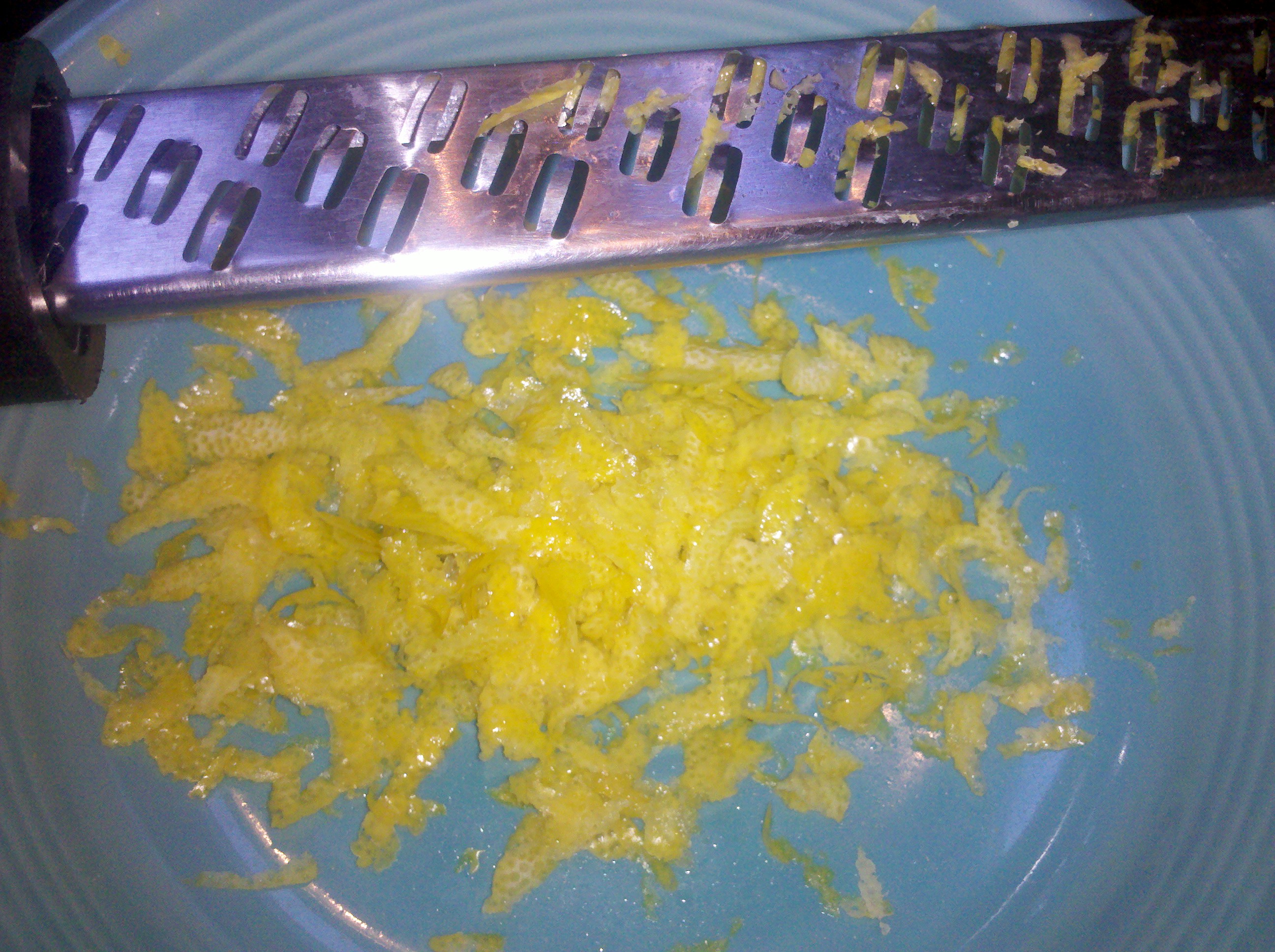
After careful deliberation and combing of the internet, I decided upon this Limoncello recipe from Epicurious. My main concern was how to zest without getting any white pith in the formula, and the Microplane zester seemed like the obvious solution. I used the fine grater (darker bowl), and my friends used the larger grater (lighter bowl). You can see the pictures below. They both did a good job:

Once we grated 30ish lemons each, we added them to four bottles of 100 proof vodka (we doubled the recipe below). Now it just needs to sit for 30 days in my basement. <insert moonshine jokes here> Next month we will reconvene and add a simple syrup to our glass containers, along with more vodka, and then it’s more waiting.

Even if this turns out to be an expensive mistake, I very much enjoyed spending the morning with my two friends grating lemons and chit chatting, just like the pioneer women of Kentucky.

Limoncello

Ingredients:

15 lemons*
2 bottles (750 ml) 100-proof vodka**
4 cups sugar
5 cups water
* Choose thick-skinned lemons because they are easier to zest.
** Use 100-proof vodka, which has less flavor than a lower proof one. Also the high alcohol level will ensure that the limoncello will not turn to ice in the freezer.

Directions:

Wash the lemons with a vegetable brush and hot water to remove any reside of pesticides or wax; pat the lemons dry.
Carefully zest the lemons with a zester or vegetable peeler so there is no white pith on the peel. NOTE: Use only the outer part of the rind. The pith, the white part underneath the rind, is too bitter and would spoil your limoncello.
Step One:
In a large glass jar (1-gallon jar), add one bottle of vodka; add the lemon zest as it is zested. Cover the jar and let sit at room temperature for at least (10) ten days and up to (40) days in a cool dark place. The longer it rests, the better the taste will be. (There is no need to stir – all you have to do is wait.) As the limoncello sits, the vodka slowly take on the flavor and rich yellow color of the lemon zest.
Step Two:
In a large saucepan, combine the sugar and water; cook until thickened, approximately 5 to 7 minutes. Let the syrup cool before adding it to the limoncello mixture. Add to the limoncello mixture from Step One. Add the additional bottle of vodka. Allow to rest for another 10 to 40 days.
Step Three:
After the rest period, strain and bottle: discarding the lemon zest. Keep in the freezer until ready to serve.

Ask Mom Mom: Book Club Food

Dear  Mom Mom,

It seems whenever I host book club or a similar event,  I tend to go way too far and put out enough food to feed the entire tri-county area.  Can you help me with finding a good balance of feeling like I’ve got enough food to satisfy without going overboard and feeling guilty for throwing out tons of food at the end of the night?  I would never want to be accused of not feeding my guests!

Signed,

Bookclub and Clueless…

Dear Most Considerate Hostess,

This is such a great question, as so many people struggle with this very dilemma. I won’t pretend to be the authority on this (okay, who am I kidding? I always pretend to be the authority), but I will tell you what I try to do in similar situations.

In a rational moment, preferably at least one week or more before your event, sit down and determine your categories of food. For example: something healthy like a crudités or salad, some sort of chip and dip, a cheese tray with nice crackers or bread, a hot appetizer, and a couple of sweet things. That’s six things, and I think that is plenty for the average sized book group. If you insist, you can have seven things, but I don’t advise it. Seven is a slippery slope to eight…

Next, depending on your level of ambition, map out your specifics. Your chip and dip category can literally be simple potato chips and onion dip, or it can be some groovy recipe you saw in Bon Appétit or Gourmet magazine last month served with high end organic chips and hard-to-find ingredients. Take it category by category, and DO NOT BE TEMPTED to add more categories. Stick to the plan! After all, this plan was hatched in a rational moment, not in a frenzy two days before your guests arrive — THAT’S when we get ourselves into trouble and overbuy.

I try to mix it up between easy and ambitious. Definitely browse my Appetizer and Dessert section here and see if anything appeals to you. Sometimes popcorn is every bit the hit as the gorgeous torte I labored over for hours (and probably spent $30 to make). Places like Costco and BJ’s have great ready-made appetizers and desserts, and while I would never advise a whole party full of them, they are decent fill-in items.

Now, I can hear you saying, “But Mom Mom, what if it’s not enough? What if I run out of food?” First, believe me, you will not. But if you are so worried about this unlikely event occurring, you can stock your pantry with a few emergency items only to be opened if nothing is left. Don’t laugh, but I suggest something really junky like Doritos and a giant bag of M&Ms. Middle aged women who are perpetually on diets go nuts over that stuff, especially after a few cocktails. Also, if you keep a box of frozen appetizers such as Cohen’s (cocktail franks and assorted puff pastry) in the freezer, within 20 minutes, you have more hot food. If your book club is anything like mine, by that point in the night, no one will notice or care. The main idea is that your “emergency food” is something that can keep in a sealed bag or frozen, and therefore will not go to waste.

Finally, remember that all of your guests are so happy to be at your house enjoying cocktails and friendship (oh, and sometimes even the book discussion), so try not to stress out too much over the food. I know that sounds silly, coming from me, but it’s true.

Julie’s Sausage Strata

Have you ever known someone for just a brief time, yet their impact on your life remains constant? I first met my friend Julie when I starting working for discount broker Brown & Company in Philadelphia. I had left the cushy mahogany row of Janney Montgomery Scott for a gritty, mostly male trade desk, and aside from my boss, Julie was the only other female in the room. In typical Dawn fashion, I just assumed we would be friends, because why not?

Julie was a tough nut to crack. Quite frankly, she scared me a little. She probably made me cry once or twice, too, during the early weeks. And I’m sure I was a tad bit annoying to her, if for no other reason than our circumstances. I was just about to get married, and she had just gone through a devastating divorce. I am sure my prissy, wide eyed enthusiasm got on her nerves, as well as some unintentional insensitivity on my part.

I didn’t go away quietly. Typically, I don’t bother with people if I don’t feel like they’re worth my time or energy, but I believed that Julie was worth it. I knew that sooner or later she would grow to like me, and I was determined to wear her down with my charm. It turned out to be our mutual love of animals which finally brought us together. She adored her English Springer Spaniel Miss Fergie, for whom she would cook dinners of lamb and rice. I adored our adopted stray calico cat Lulu, who I treated like a child. When one pet lover finds another pet lover, bridges are created, and through those fur covered bridges eventually grew a friendship.

Julie taught me so many things that I couldn’t begin to list them all. She never intended to teach me anything, but just by being herself, I learned a lot. In many ways, she was like a big sister to me. I loved the way she dealt with our difficult customers. It’s hard to explain, but the she always managed to show them who was boss and control the situation without ever being overtly rude. Overtly is the key word in that sentence. All of our conversations were recorded and frequently we would have to go back to the tapes to verify disputed trades, and one quickly learns to keep one’s cool on a recorded line. This skill never came naturally to me in times of high pressure, so I tried to imagine how Julie would handle the situation and just imitated her.

In no particular order, here are some of the things Julie introduced to me: embossed monogrammed stationery (in white, always white), Martha Stewart before she was a household name, the city of Burlington, Vermont, Beaujolais Nouveau, Kir, quilted china storage sets, high thread count sheets, trunk sales, Grace Kelly postage stamps, Scotch (which I still can’t drink), knitting (which I still can’t do), Talbot’s boiled wool jackets, and the notion that truly wealthy people drive old and modest cars. These are things which Mayflower descendents just know.

When it came time to host my first big brunch, naturally I turned to Julie. She quickly scribbled down two recipes: Amy David’s Sausage Strata and Susan Moore’s To-Die-For Potatoes. I have been making both of these dishes for eighteen years now, and I think of Julie every time I get out those recipe cards. I will share the sausage strata today, and the potatoes at a later date.

Sausage strata recipes are a dime a dozen, but this one is special to me since it came from my old friend. It’s not particularly fancy, but it’s easy, delicious, satisfying, and always a hit. Julie has also taught me to stick with the classics, especially if they work.


Julie’s Sausage Strata, courtesy of Amy David

6 slices white bread (crusts cut off)

1 lb. sausage meat (mild)

1 t. mustard (I always use Dijon)

1 cup grated Swiss (I am not a fan of Swiss but it works well in this recipe, trust me)

3 eggs lightly beaten

1 cup half and half

1/4 t. salt

dash of pepper

dash of nutmeg

Preheat oven to 350 degrees.

Grease 13 x 9 Pyrex dish

Cook sausage, drain, and toss with mustard. Arrange bread in bottom of dish. Top with sausage. Cover with remaining ingredients. Bake uncovered for 35 minutes.