The Pioneers of Chester County: Chicken Tortilla Soup

My friend had the great idea of reuniting our limoncello crew to make something a little more family friendly, and I was all for it! We decided to go with a soup, and The Pioneer Woman’s Chicken Tortilla Soup seemed to get high marks based on the almost 500 comments on her blog. Not jealous. Really, I’m not. She’s great. But if you want to make any comments here, I sure wouldn’t mind…

We gathered in my friend’s beautiful kitchen, pots in hand, and got to work tripling the recipe. Can you believe I’ve never had chicken tortilla soup? Or ANY tortilla soup? I am always amazed at how little I know about the world.

Three pots for three friends

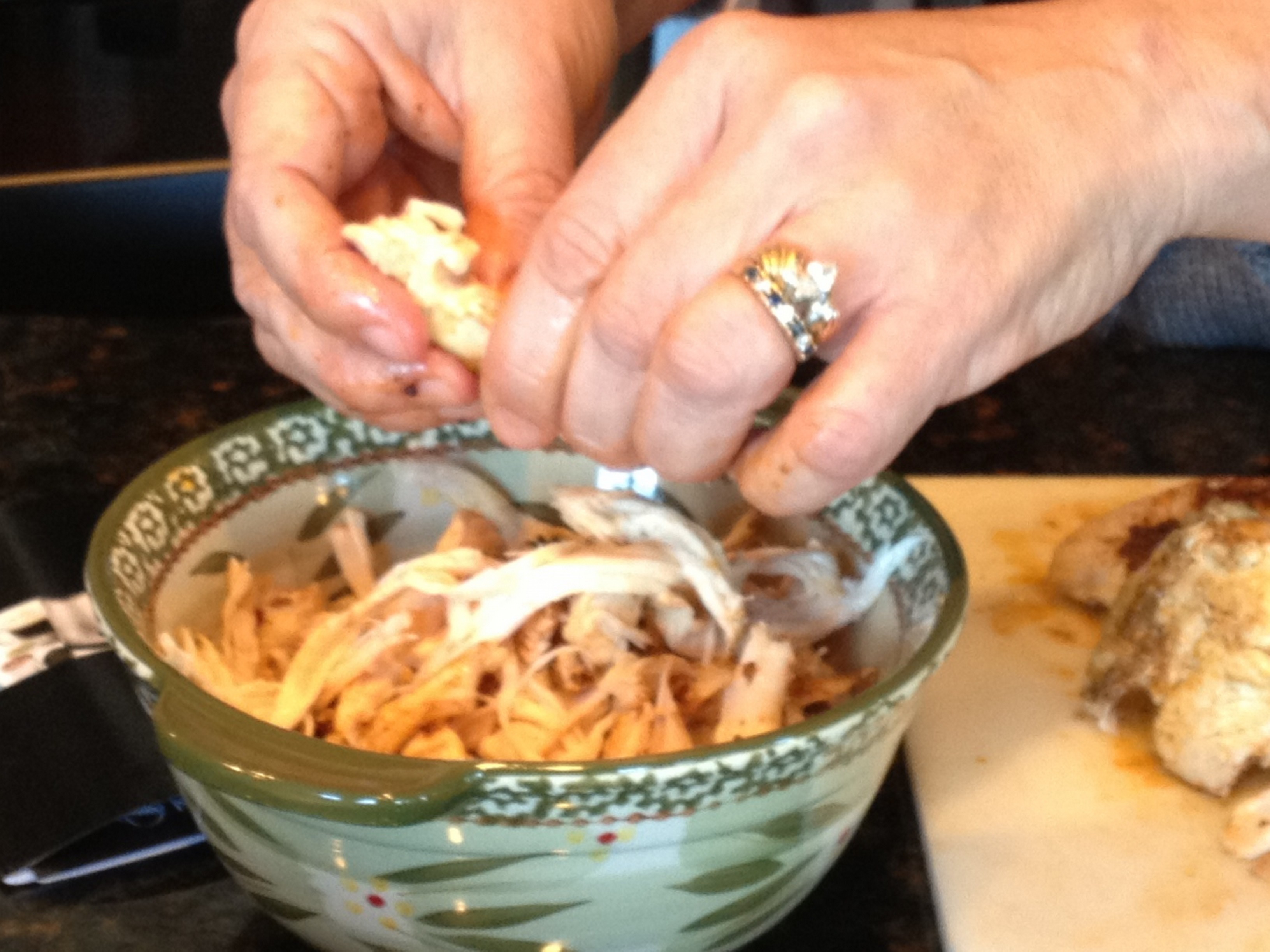
Picking apart boneless chicken, just like Laura Ingalls Wilder

Beans and Rotel

The final, delicious product.

The verdict: I am calling this soup a success. There were a grand total of fifteen of us who ate this soup for dinner tonight. All three of the husbands loveloveloved it. All three of us pioneer women of Chester County loved it, too. Three children liked it well enough. Two children cried about it. One picky eater ate a small amount. And two boys were too busy with sports to try it as of this publishing, but my prediction is that they will like it. While the soup is very flavorful (one of my son’s called it a burrito in a bowl), I think the toppings really make it shine. Cilantro is a must (unless you think it tastes like soap) and cheese and sour cream and avocado, too.

The Pioneer Woman’s Chicken Tortilla Soup (original printable recipe here)

Ingredients

  • 2 whole Boneless, Skinless Chicken Breasts
  • 1 Tablespoon Olive Oil
  • 1-½ teaspoon Cumin
  • 1 teaspoon Chili Powder
  • ½ teaspoons Garlic Powder
  • ½ teaspoons Salt
  • 1 Tablespoon Olive Oil
  • 1 cup Diced Onion
  • ¼ cups Diced Green Bell Pepper
  • ¼ cups Red Bell Pepper
  • 3 cloves Garlic, Minced
  • 1 can (10 Oz. Can) Rotel Tomatoes And Green Chilies
  • 32 ounces, fluid Low Sodium Chicken Stock
  • 3 Tablespoons Tomato Paste
  • 4 cups Hot Water
  • 2 cans (15 Oz. Can) Black Beans, Drained
  • 3 Tablespoons Cornmeal Or Masa
  • 5 whole Corn Tortillas, Cut Into Uniform Strips Around 2 To 3 Inches
  • _____
  • FOR THE GARNISHES:
  • Sour Cream
  • Diced Avocado
  • Diced Red Onion
  • Salsa Or Pico De Gallo
  • Grated Monterey Jack Cheese
  • Cilantro

Preparation Instructions

Preheat oven to 375 degrees. Mix cumin, chili pepper, garlic powder, and salt. Drizzle 1 tablespoon olive oil on chicken breasts, then sprinkle a small amount of spice mix on both sides. Set aside the rest of the spice mix.

Place chicken breasts on a baking sheet. Bake for 20 to 25 minutes, or until chicken is done. Use two forks to shred chicken. Set aside.

Heat 1 tablespoon olive oil in a pot over medium high heat. Add onions, red pepper, green pepper, and minced garlic. Stir and begin cooking, then add the rest of the spice mix. Stir to combine, then add shredded chicken and stir.

Pour in Rotel, chicken stock, tomato paste, water, and black beans. Bring to a boil, then reduce heat to a simmer. Simmer for 45 minutes, uncovered.

Mix cornmeal with a small amount of water. Pour into the soup, then simmer for an additional 30 minutes. Check seasonings, adding more if needed—add more chili powder if it needs more spice, and be sure not to undersalt. Turn off heat and allow to sit for 15 to 20 minutes before serving. Five minutes before serving, gently stir in tortilla strips.

Ladle into bowls, then top with sour cream, diced red onion, diced avocado, pico de gallo, and grated cheese, if you have it! (The garnishes really make the soup delicious.)


Moosewood’s Fragrant Rice Noodles with Vegetables

We decided a few weeks ago that on Mondays we would serve a vegetarian dinner and call it Vegetable Monday. I am sure our 30+ days of high calorie, nutritionally-void holiday food and tight jeans may have inspired this grand proclamation, but I’m kind of digging it. This replaces our once popular Pizza Monday, so you can imagine how the kids feel about this. They probably refer to it as Arsenic Monday behind our backs.

This comes from one of my favorite cookbooks, Moosewood Restaurant Cooks at Home. I am modifying it a bit tonight for our meal, but I will share the original version first, and then my adjustments. My kids like broccoli and peppers, so I threw them in there. They also like rice instead of rice noodles. And, oh, did I mention they won’t eat the sauce? Basically, I’m just making this for Ed and myself.

Don’t be put off by the name. “Fragrant” somehow doesn’t feel like a good food word to me, although it is certainly evocative. Fragrant is too close to fragrance (i.e. perfume or Glade air freshener), and that’s not something I want in my food. Plus, this is peanut based, but you’d never know it from the name, would you?

This sauce is a winner. I always double it, since Ed prefers his food drowning in sauce, but I seriously don’t suggest doing that unless you have sauce addiction issues like my husband. I also like to add a bit of crushed red pepper for some heat, just a 1/4 to 1/2 teaspoon. As you can see below, we used two different blends of veggies (Vegetable Monday, was I lying?). I love this recipe with rice noodles or pasta, but it works equally well with plain old rice, too.

Moosewood’s Fragrant Rice Noodles with Vegetables

Ingredients

1 1/2 quarts water
SAUCE
2 tablespoons fresh lime juice
1 tablespoon freshly grated lime peel
1/2 cup peanut butter (preferably smooth)
2 teaspoons brown sugar
1 cup vegetable stock
1/2 teaspoon salt
3 garlic cloves, minced or pressed
xxxxxxxxxx
Noodles and Veggies (feel free to add or subtract to taste):
6 ounces 1/4-inch-wide rice noodles (or linguini if rice noodles are unavailable)
2 leeks, well rinsed
2 small zucchini
2 small yellow squash
3 tablespoons vegetable oil
1/4 cup water
xxxxxxxxxxxxxxxx
Directions:
In a covered pot, bring the water to a rapid boil. Combine the sauce ingredients and mix them by hand or puree them in a blender until smooth. When the water boils, add the noodles and cook for 3 to 5 minutes, until just tender. Drain, rinse briefly under cool water, drain again, and set aside.
Cut the leeks, zucchini, and yellow squash into sticks 5 to 6 inches long and 1/4 to 1/2 inch wide. Heat the oil in a wok or large skillet. Stir-fry the leek sticks on medium-high heat for 2 to 3 minutes. Add the zucchini and yellow squash and continue to stir-fry for about 3 to 4 minutes, until the vegetables are just tender. To prevent scorching or sticking, add about 1/4 cup water while stir-frying. Add the noodles (or pasta) and the sauce and toss well until heated through. Serve at once.

Chicken Corn Chowder

One of my favorite food blogs which I recently discovered is Growling Tummy. As soon as I saw this recipe for Chicken Corn Chowder, I knew it had high potential. And I was right! Four out of five family members loved it (even Mr. Picky), and the only one who didn’t finish it practically fell asleep in his soup due to a very fun sleepover birthday party at the Great Wolf Lodge…so I am not blaming the recipe! Ed said it reminded him a bit of the soup version of chicken pot pie, and I agree. The jalapeno gave it a wonderful kick, and the roasted red pepper added nice color and flavor. I used a rotisserie chicken, too, which made this soup incredibly quick and easy to prepare (albeit a bit pricier). I will definitely be making this again!

Growling Tummy’s Chicken Corn Chowder

Ingredients:

  • 2 tablespoons butter
  • 1/2 cup chopped onion
  • 1/2 cup chopped celery
  • 2 medium potatoes, chopped
  • 1 jalapeño pepper, seeded and minced
  • 3 tablespoons all-purpose flour
  • 3 cups reduced-fat milk
  • 2 cups reduced sodium chicken broth
  • 2 cups chopped roasted skinless, boneless chicken breasts, rotisserie chicken works great here (vegetarians can omit the chicken and its still a great chowder)
  • 1 1/2 cups fresh or frozen corn kernels (about 3 ears, but you can use frozen)
  • 1/4 teaspoon ground red pepper
  • salt to taste
  • 2 roasted red peppers from a jar, chopped
  • 1 (14 3/4-ounce) can cream-style corn

How To:

Melt the butter in a large Dutch oven over medium heat. Add onion, celery, potato and jalapeño and cook for 3 minutes or until tender, stirring frequently. Add flour; cook for 1 minute, stirring constantly. Stir in milk and remaining ingredients. Bring to a boil and cook until thick (about 5 minutes). Reduce heat and serve (biscuits work great as a compliment).

Bagels and Butter

We are lucky to have good bagels around here. Our local bagel store used to be owned by a woman who I called the “Bagel B____ (rhymes with witch),” or BB, for short. I’m pretty sure I’m not the only person who called her that. God, she was vile. I worked with NYSE floor traders who had more patience than this woman. And I was (for the most part) a very good, very efficient bagel orderer.  99% of the time I knew exactly what I wanted and spoke in a clear, concise fashion with no dilly dallying, and she was still miserable and rude. Fortunately, a much nicer man has since bought the store, and I am now safe to modify my order without BB’s scorn.

I am so very proud of myself. Yesterday I made bagels for the first time and homemade butter for the second time. Both were surprisingly easy. Luisa, my favorite food blogger at The Wednesday Chef, shared Peter Reinhart’s Amazing and Almost Idiot-Proof Recipe, and I was inspired to try myself. Assuming I can keep up with a good workout schedule, I am thinking of making bagels weekly. Or, at least, monthly. In any event, they are so good that I am already dreaming of next time.

The butter I made on a whim, after reading an article in Fancy Fine Cooking. I just felt like my special bagels deserved good butter. Plus, I’m kind of a show-off.

Two pieces of advice: DOUBLE THIS RECIPE! I made seven bagels, and in retrospect, I wish I would have made six larger ones instead. Twelve decent sized bagels instead of seven smaller ones would have been perfect. And start this recipe ONE DAY BEFORE you want to eat bagels (see step 7: refrigerate overnight).

Bagels, The Los Angeles Times, November 12, 2008

Total time: 1 hour, 15 minutes plus chilling, rising and cooling time for the dough and bagels

Servings: 6 to 8 bagels

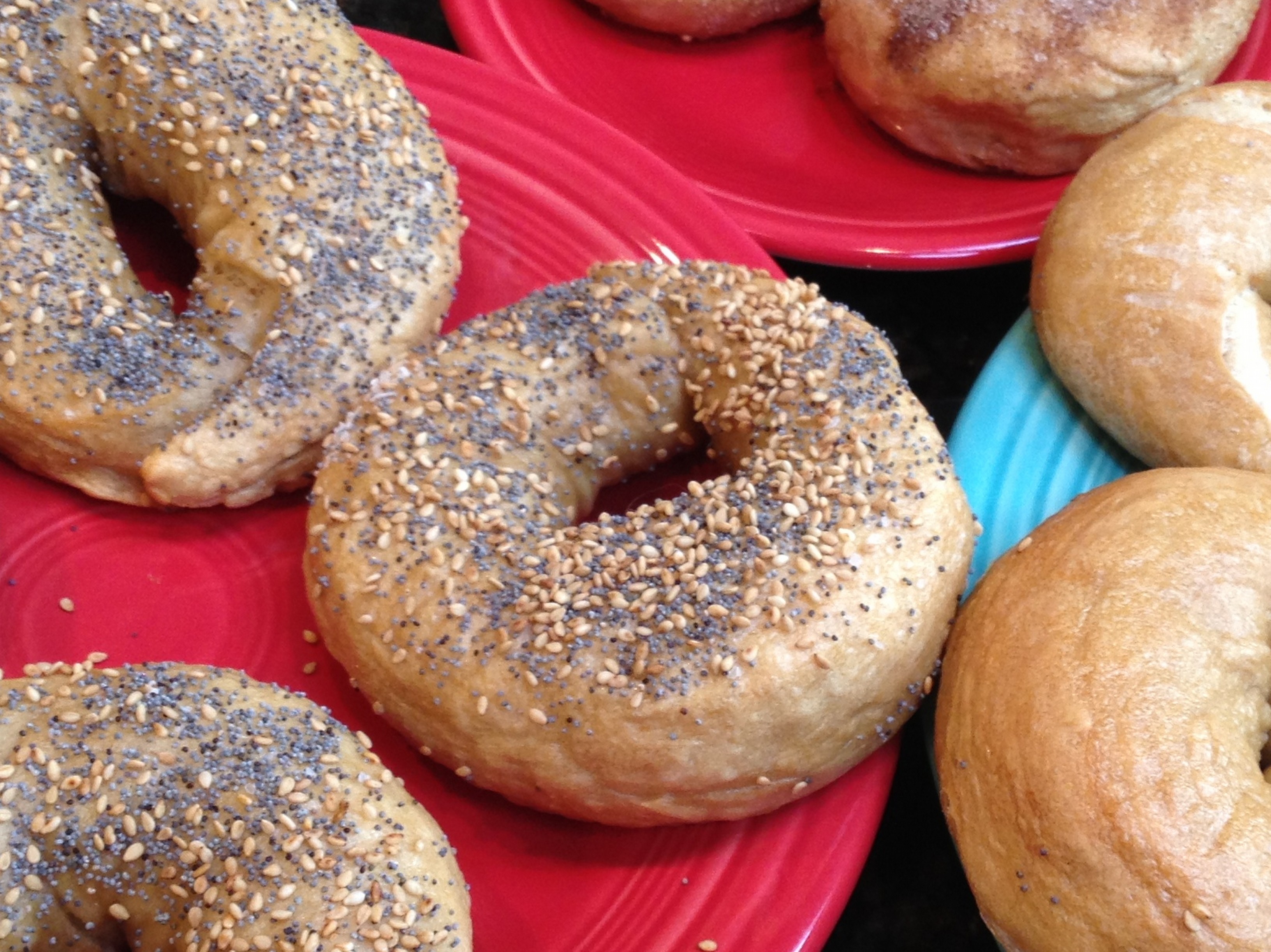
Note: Barley malt, also known as barley malt syrup, is generally available at health food stores including Erewhon Natural Foods in Los Angeles and Granny’s Pantry in Pasadena, as well as at most Whole Foods Market stores. Instant yeast is generally available at cooking and baking supply stores. Despite the short work time, this recipe takes two days to make because of the rising time. If you make more than 6 bagels, you may need to prepare 2 baking sheets. Toppings can include poppy or sesame seeds, coarse salt, dehydrated onion or garlic bits that have been soaked, and cinnamon sugar.

3 1/2 cups (1 pound) unbleached bread flour

3 teaspoons salt, divided

3/4 teaspoon instant yeast

1 tablespoon barley malt syrup (or honey)

1 cup plus 2 tablespoons water

1 teaspoon baking soda

Toppings as desired

1. In the bowl of an electric mixer or food processor or by hand, mix the flour, 2 teaspoons salt, the yeast, barley malt syrup and 1 cup plus 2 tablespoons water until the ingredients form a stiff, coarse ball of dough (about 3 minutes if mixing by hand or in a mixer; or 1 minute in a food processor). If necessary, add a little more water. Let the dough rest 5 minutes.

2. Knead the dough on a lightly floured surface until the dough feels stiff yet supple, with a satiny, slightly tacky feel, 2 to 3 minutes. If the dough seems too soft or too tacky, sprinkle over just enough flour as needed.

3. Place the dough in a lightly oiled bowl, cover tightly with plastic wrap, and place it in the refrigerator for at least 1 hour and up to several hours. Keep in mind that the bagels must be shaped before proofing overnight.

4. When ready to shape the bagels, line a baking sheet with lightly greased parchment paper or a silicone baking mat.

5. Remove the dough from the refrigerator and divide it into 6 to 8 equal pieces. Form each piece into a loose, round ball by rolling it on a clean, dry work surface with a cupped hand; do not use any flour on the surface. If the dough slides around and won’t ball up, wipe the work surface with a damp paper towel and try again — the slight amount of moisture will provide enough “bite” for the dough to form a ball. When each piece has been formed into a ball, you are ready to shape the bagels.

6. Using your hands and a fair amount of pressure, roll each dough ball into a “rope” 8 to 10 inches long. (Moisten the work surface with a damp paper towel, if necessary, to get the necessary bite or friction). Slightly taper the rope at the ends so that they are thinner than the middle. Place one end of the dough between your thumb and forefinger and wrap it around your hand until the ends overlap in your palm; they should overlap by about 2 inches. Squeeze the overlapping ends together and then press the joined ends into the work surface, rolling them back and forth a few times until they are completely sealed.

7. Remove the dough from your hand and squeeze as necessary to even out the thickness so that there is a 2-inch hole in the center. Place the bagel on the prepared sheet pan. Repeat with the other pieces. Lightly wipe the bagels with oil, cover with plastic wrap and place in the refrigerator overnight.

8. Remove the bagels from the refrigerator 90 minutes before you plan to bake them. Fill a large stockpot with 3 quarts of water (be sure the water is at least 4 inches deep), cover with a lid, and slowly bring the water to a boil. When it comes to a boil, add the remaining teaspoon of salt and 1 teaspoon of baking soda, reduce the heat and simmer with the lid on.

9. Thirty minutes before baking, heat the oven to 500 degrees.

10. Test the bagels by placing one in a bowl of cold water. If it sinks and doesn’t float to the surface, return it to the sheet, wait 15 minutes and then test it again. When one bagel passes the float test, they are ready for the pot.

11. Gently lift each bagel and drop it into the simmering water. Add as many as will comfortably fit in the pot. After 1 minute, use a slotted spoon to flip each bagel over. Poach for an extra 30 seconds. Using the slotted spoon, remove each bagel and return it to the lined baking sheet. Continue until all the bagels have been poached. Generously sprinkle each bagel with a topping, except for cinnamon sugar (see note below).

12. Place the baking sheet in the oven and reduce the heat to 450 degrees. Bake for 8 minutes and then rotate the sheet (if using two sheets, also switch their positions). Check the underside of the bagels. If they are getting too dark, place another sheet under the baking sheet (i.e., double-pan it). Bake until the bagels are golden brown, an additional 8 to 12 minutes. Remove from the oven and transfer the bagels to a rack for at least 30 minutes before serving.

Note: If using cinnamon sugar (1 part cinnamon to 5 parts granulated sugar), immediately brush the top of each hot bagel with melted butter and then generously sprinkle with the mixture so that it is coated. It will form a nice cinnamon crust as it cools.

Each of 8 servings: 226 calories; 7 grams protein; 46 grams carbohydrates; 2 grams fiber; 1 gram fat; 0 saturated fat; 0 cholesterol; 1,031 mg. sodium.

Step 3, the dough ball
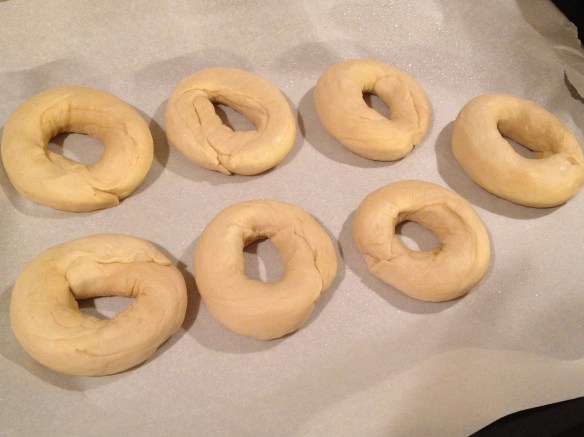
Step 6, formed in O shape
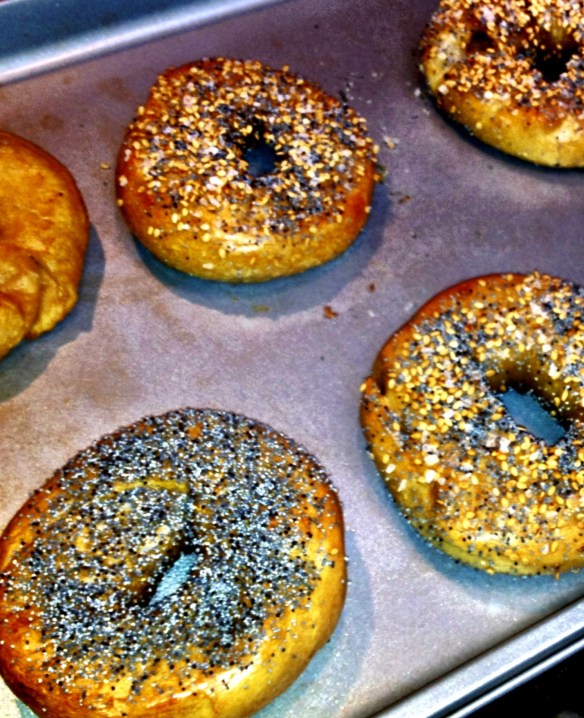
Step 12, hot out of the oven

Homemade Butter by Daniel Leader, Fine Cooking, December 2011

Ingredients

Heavy Cream

1/4 teaspoon kosher salt

In a stand mixer fitted with the whisk attachment, whip 2 cups of heavy cream on medium speed until medium peaks form, about 3 minutes. Put a splatter guard on the bowl or drape a kitchen towel over the mixer and the bowl. Increase the speed to high and continue whipping until the solids separate from the buttermilk (you will hear sloshing), about 8 minutes.

Gather the butter into a ball and put it in a strainer. Rinse under cold water, squeezing with your hands, until the water runs clear, about 1 minute. Knead in 1/4 tsp. sea or kosher salt and shape the butter as you like. Pat it dry with a paper towel, wrap in plastic, and refrigerate for up to a month.

Notes from Dawn: This is obviously super easy as long as you have a heavy duty mixer. 8 minutes is a long time to run a mixer not equipped for such work, so make sure your mixer is up to this task. It is also quite a mess. TOTALLY worth it, but be prepared to clean up a bit.

You’re probably thinking the picture below is not such a mess and I must be a total princess. Oh, you just wait! This is only the first part where it’s still glorified whipped cream.

Okay, was I lying? Isn’t that awful?

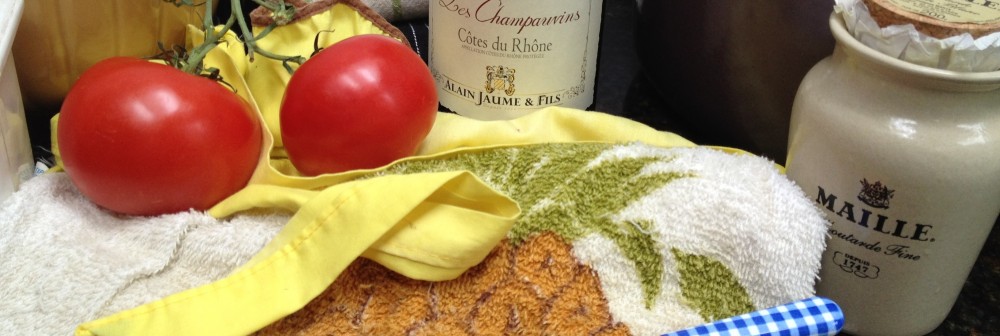
But the final product is so delicious and the perfect accompaniment to fresh baked bagels or bread. Voila!

Poule au Pot: French Chicken in a Pot

Everywhere I turn these days, my boyfriend Christopher Kimball is out and about promoting The Cook’s Illustrated Cookbook: 2000 Recipes from 20 Years of America’s Most Trusted Cooking Magazine. Within one week, I heard him on NPR’s Fresh Air and another show I can’t recall (The Splendid Table, maybe?) and both times he was singing the praises of Poule au Pot, otherwise known as “chicken in a pot” to us commoners.

Roasted chicken is a hands-down favorite around here. For all the fancy stuff I try to shove on my family, simple chicken and gravy is always a winner. Poule au Pot is cooked at 250 degrees, low and slow and covered tightly. Needless to say, this is not roasted and you will be sacrificing brown and crispy skin. The tradeoff, however, is soooooo worth it. This chicken is incredibly juicy and intensely flavored, and yet it is a magically, deceptively simple recipe which uses very few ingredients. Our friends at Cook’s Illustrated have figured out that too many vegetables creates too much humidity inside the pot and diminishes the flavor of the chicken. By using just a small amount of aromatics which were browned first, they achieved the flavor infusion without washing out the chicken with too much humidity.

Do not go overboard with the veggies. Shown below is a small bowl of everything aside from salt and pepper which I used, and you can see it’s not much. But when you put it all together and follow the directions? Magic.

French Chicken in a Pot
from the January 2008 edition of Cook’s Illustrated

The cooking times in the recipe are for a 4 1/2 to 5 pound bird. A 3 1/2 to 4 1/2 pound bird will take about an hour, an a 5 to 6 pound bird will take close to two hours. We developed this recipe to work with a 5 to 8 quart pot with a tight-fitting lid. If using a 5-quart pot, do not cook a chicken larger than 5 pounds.

1 whole roasting chicken, giblets removed and discarded, wings tucked under back
2 teaspoons kosher salt or 1 teaspoon table salt
1/4 teaspoon black pepper
1 tablespoon olive oil
1 small onion, chopped medium
1 small celery stick, chopped medium
6 medium garlic cloves, peeled and trimmed
1 bay leaf
1 medium spring of rosemary
1/2-1 teaspoon fresh lemon juice

1. Adjust oven rack to lowest position and heat oven to 250 degrees. Pat chicken dry with paper towel and season with salt and pepper. Heat oil in large Dutch oven over medium heat until just smoking. Add chicken breast-side down; scatter onion, celery, garlic, bay leaf and rosemary around chicken. Cook until breast is lightly browned, about 5 minutes. Using a wooden spoon inserted into cavity of bird, flip chicken breast side up and cook until chicken and vegetables are well browned, 6 to 8 minutes. Remove Dutch oven from heat; place large sheet of foil over pot and cover tightly with lid. Transfer pot to oven and cook until an instant read thermometer registers 160 degrees when inserted in the thickest part of the breast and 175 degrees in the thickest part of the thigh, 80 to 110 minutes.

2. Transfer chicken to carving board, tent with foil and rest 20 minutes. Meanwhile, strain chicken juices from pot through a fine-mesh strainer into fat separator, pressing on solids to extract liquid; discard solids (you should have about 3/4 cup juices). Allow liquid to settle 5 minutes, then pour into saucepan and set over low heat. Carve chicken, adding any accumulated juices to saucepan. Stir lemon juice into jus to taste. Service chicken, passing jus at table.

Orangette’s Vegetable and Pearl Barley Soup

One of the things I love the most about receiving and sharing recipes is the feeling of connection which occurs every time you prepare the food. I can’t make sausage strata without remembering my friend Julie. I can’t make Mexican casserole without remembering my friend Bonnie. I can’t make white bean dip without remembering my friend Suzanne. These women and many more are immortalized in my food simply by the act of sharing their favorite recipes, and that is no small thing. It is for that very reason that I strive to post only good and worthwhile recipes here and not waste your time with anything mediocre; I want to be remembered by you fondly. No one achieves immortality through dry banana bread.

As a new blogger, one of the joys I’m experiencing is connecting with friends and relatives from near and far. Chances are, if you’re reading this blog, we have four degrees of separation or less. You either know me personally or you know someone who knows me or you’re related to me in some fashion. Two such people are my cousins Linda and Beth, who have been very encouraging and supportive of my blog. Beth recently linked me Molly Wizenberg’s rather famous food blog Orangette, and while I was familiar with Molly’s name as an avid NPR listener and Bon Appetit reader (as well as being mentioned by my favorite food blogger, The Wednesday Chef), I had never read her blog. I can see now why it is so beloved! The really inspiring part was learning how, like me, Molly just decided one day to do what she loved: cooking and writing. And also like me, she didn’t let lack of proficient knife skills and a journalism degree hold her back!

This recipe is a keeper. As Molly wrote, it doesn’t look like much. If I didn’t hear how good it is from a reputable source, I would have passed it by without a second thought. I’m so glad I didn’t! Believe it or not, this is the first time I have ever cooked with parsnips. (And how cool are parsnips? They remind me of vampire carrots.) Whenever I have parsnips from now on, I will think of Molly’s blog and the first time I ever used them, and whenever I read Molly’s blog, I will think of my cousin Beth who introduced me to Orangette. Food is so much more than something to eat.

Orangette’s Vegetable and Pearl Barley Soup
Adapted from Great British Food, by Cass Titcombe, Patrick Clayton-Malone, and Dominic Lake

A few notes from Orangette:
– I used homemade chicken stock to make this soup, but you could also use good-tasting store-bought chicken or vegetable stock. To me, the best brand is Better Than Bouillon.
– If your celery comes with leaves still attached, save them! Toss in a small handful when you add the cabbage, toward the end.
– Instead of parsnips, try peeled, cubed rutabaga.

3 Tbsp. olive oil
1 large yellow or sweet onion, diced
150 grams (3 or 4 stalks) celery, peeled and diced
150 grams (about 3 medium) parsnips, peeled, cored, and diced
150 grams (about 3 medium) carrots, peeled and diced
150 grams (1 large) leeks, diced
3 large garlic cloves, chopped
Leaves from a few sprigs of fresh thyme
1 ½ liters chicken or vegetable stock
Salt
50-60 grams pearl barley (Dawn used about half a cup)
A couple handfuls of shredded Savoy cabbage or Brussels sprouts
Freshly ground black pepper

Warm the olive oil in a Dutch oven or small stockpot. Add the onion, celery, parsnips, carrots, and leeks, and stir to coat with oil. Cook, stirring occasionally, for about 15 minutes, or until softened. Do not allow to brown. Add the garlic and thyme leaves, and cook for a few minutes more. Then add the stock and a couple of good pinches of salt. Bring to a boil, lower the heat to maintain a gentle simmer, and cook for 10 minutes. Then stir in the pearl barley, and simmer gently for 20 minutes, stirring occasionally. Add the Savoy cabbage or Brussels sprouts, and simmer for 5 minutes more. Taste, and add salt as needed. Serve hot, with freshly ground black pepper, if you like.

Yield: 4 to 6 servings

Julie’s Sausage Strata

Have you ever known someone for just a brief time, yet their impact on your life remains constant? I first met my friend Julie when I starting working for discount broker Brown & Company in Philadelphia. I had left the cushy mahogany row of Janney Montgomery Scott for a gritty, mostly male trade desk, and aside from my boss, Julie was the only other female in the room. In typical Dawn fashion, I just assumed we would be friends, because why not?

Julie was a tough nut to crack. Quite frankly, she scared me a little. She probably made me cry once or twice, too, during the early weeks. And I’m sure I was a tad bit annoying to her, if for no other reason than our circumstances. I was just about to get married, and she had just gone through a devastating divorce. I am sure my prissy, wide eyed enthusiasm got on her nerves, as well as some unintentional insensitivity on my part.

I didn’t go away quietly. Typically, I don’t bother with people if I don’t feel like they’re worth my time or energy, but I believed that Julie was worth it. I knew that sooner or later she would grow to like me, and I was determined to wear her down with my charm. It turned out to be our mutual love of animals which finally brought us together. She adored her English Springer Spaniel Miss Fergie, for whom she would cook dinners of lamb and rice. I adored our adopted stray calico cat Lulu, who I treated like a child. When one pet lover finds another pet lover, bridges are created, and through those fur covered bridges eventually grew a friendship.

Julie taught me so many things that I couldn’t begin to list them all. She never intended to teach me anything, but just by being herself, I learned a lot. In many ways, she was like a big sister to me. I loved the way she dealt with our difficult customers. It’s hard to explain, but the she always managed to show them who was boss and control the situation without ever being overtly rude. Overtly is the key word in that sentence. All of our conversations were recorded and frequently we would have to go back to the tapes to verify disputed trades, and one quickly learns to keep one’s cool on a recorded line. This skill never came naturally to me in times of high pressure, so I tried to imagine how Julie would handle the situation and just imitated her.

In no particular order, here are some of the things Julie introduced to me: embossed monogrammed stationery (in white, always white), Martha Stewart before she was a household name, the city of Burlington, Vermont, Beaujolais Nouveau, Kir, quilted china storage sets, high thread count sheets, trunk sales, Grace Kelly postage stamps, Scotch (which I still can’t drink), knitting (which I still can’t do), Talbot’s boiled wool jackets, and the notion that truly wealthy people drive old and modest cars. These are things which Mayflower descendents just know.

When it came time to host my first big brunch, naturally I turned to Julie. She quickly scribbled down two recipes: Amy David’s Sausage Strata and Susan Moore’s To-Die-For Potatoes. I have been making both of these dishes for eighteen years now, and I think of Julie every time I get out those recipe cards. I will share the sausage strata today, and the potatoes at a later date.

Sausage strata recipes are a dime a dozen, but this one is special to me since it came from my old friend. It’s not particularly fancy, but it’s easy, delicious, satisfying, and always a hit. Julie has also taught me to stick with the classics, especially if they work.


Julie’s Sausage Strata, courtesy of Amy David

6 slices white bread (crusts cut off)

1 lb. sausage meat (mild)

1 t. mustard (I always use Dijon)

1 cup grated Swiss (I am not a fan of Swiss but it works well in this recipe, trust me)

3 eggs lightly beaten

1 cup half and half

1/4 t. salt

dash of pepper

dash of nutmeg

Preheat oven to 350 degrees.

Grease 13 x 9 Pyrex dish

Cook sausage, drain, and toss with mustard. Arrange bread in bottom of dish. Top with sausage. Cover with remaining ingredients. Bake uncovered for 35 minutes.


Food and Wine Vietnamese Chicken Salad

This is a recipe from one of my old Food & Wine cookbooks. It’s perfect to serve for a luncheon, as I did yesterday with my husband’s two beautiful nieces. The ladies insisted it was good enough for this blog (I have such high publishing standards here, you know), so I snapped a quick picture. This salad is the rare combination of light yet substantial: low in fat, high in flavor, and decent nutritional value.

The one thing I might do differently is add a bit more red pepper flakes, or perhaps even some freshly diced hot peppers, assuming my fellow diners liked things hot. I have found it’s worth the effort to shred the cabbage in the food processor rather than just use a bag of cole slaw, but if you’re short on time or lacking a food processor, bagged cole slaw will do just fine.

Food & Wine Vietnamese Chicken Salad

Ingredients

1 1/3 pounds boneless, skinless chicken breasts (about 4)

1 cup canned low-sodium chicken broth or homemade stock

4 scallions including green tops, chopped

1/2 teaspoon salt

1 1/4 pounds green cabbage (about 1/2 head), shredded (about 4 cups)

3 carrots, grated

6 tablespoons chopped fresh mint and/or cilantro (optional)

1/4 cup lime juice (from about 2 limes)

1/4 cup soy sauce or Asian fish sauce (nam pla or nuoc mam)

4 teaspoons sugar

1/4 teaspoon dried red-pepper flakes

1/4 cup chopped peanuts

Directions:

  1. Cut each chicken breast into five diagonal strips. In a medium saucepan, combine the broth, 1/4 of the scallions, and 1/4 teaspoon of the salt. Bring to a simmer, add the chicken, stir, and cover the pan. Cook over low heat for 5 minutes. Turn the heat off and let the chicken steam for 5 minutes. Remove the chicken from the pan and shred it.
  2. In a large bowl, combine the shredded chicken, the remaining scallions, the cabbage, carrots, and 4 tablespoons of the herbs, if using. In a small glass or stainless-steel bowl, whisk together the lime juice, soy sauce, sugar, red-pepper flakes, and the remaining 1/4 teaspoon salt. Toss the salad with the dressing. Sprinkle with the remaining 2 tablespoons chopped herbs and the peanuts.

Artichoke Pepper Feta Pizza

Pizza is probably my biggest dietary weakness. I have seen friends and family lose impressive amounts of weight by going low carb/no carb, but any diet that does not allow pizza in my life is no diet for me. That could possibly explain a lot! Sorry, I don’t want to live in a world without pizza. What kind of a life is that?

This recipe is an oldie but a goodie. I found it in the mid-1990s in Cooking Light, but unfortunately, I no longer have the original copy, nor can I find it online. You will just have to trust my decrepit memory! This may be slightly different than the original Cooking Light recipe, but I do want to give them credit for the general spirit of this.

Artichoke Feta Pepper Pizza

1 can artichokes, drained
1/4 cup mayo or light mayo
1/4 to 1/2 teaspoon crushed red pepper flakes
2 cloves of garlic, minced
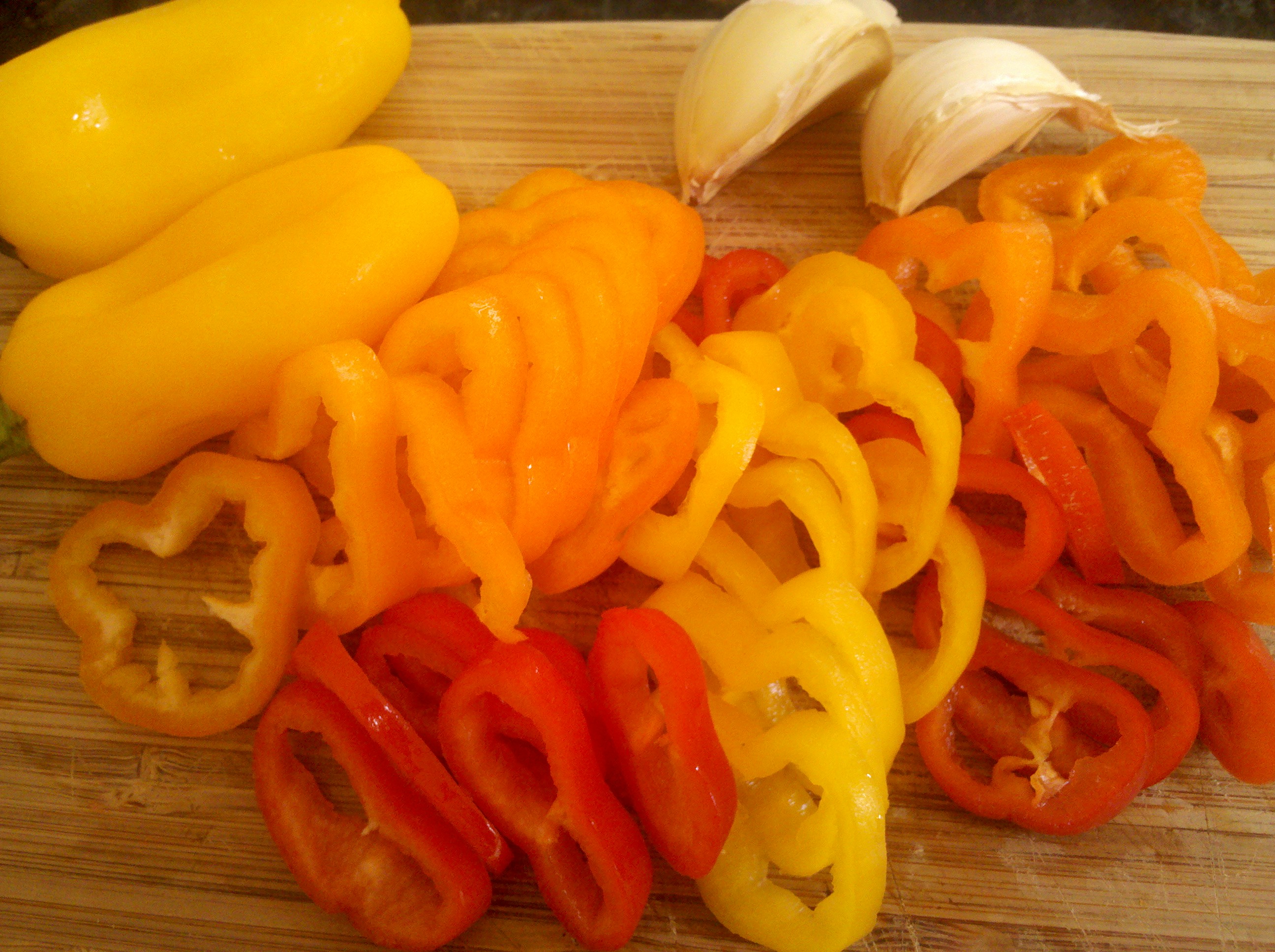
Red and/or orange pepper slices, or several baby peppers, shown above
Crumbled feta (better feta = better pizza)
Sliced black olives (I use kalamata)
Thyme
1 Boboli crust or 4 Naan or other smaller flat bread

In food processor, combine drained artichokes, mayo, red pepper flakes and garlic until smooth and spreadable.

Slice pepper into strips and saute in 1 t. olive olive and 1 clove minced garlic until softened, about five minutes.

Spread artichoke mixture on Boboli, then top with peppers, feta and olives. Sprinkle a little thyme on top.

Bake at 450 for about 10 minutes, directly on rack. Enjoy!

This is what it looks like before it goes in the oven. Since today is a busy day, I prepped it ahead of time, and I’ll just heat it up right before dinner. Serve with a side salad and feel almost healthy.


Hurricane Irene Baked Penne with Sausage and Peppers

Severe weather makes me want to cook. Quite possibly this is due to our frequent and sometimes prolonged power outages and fear of losing my refrigerator’s contents.

Today I was determined to use the last of the tomato crop to make homemade sauce, something I have never done before with fresh tomatoes. I blanched and then peeled and then simmered and then congratulated myself on being such an outstanding homemaker, the kind who makes fresh sauce right before a hurricane. Pride is a sin; when will I learn that? I was grinding some sea salt into my sauce when — BOOM! — the top broke off and dumped about 20 tablespoons of salt into my pot. Then I cried a little.

All that work down the drain!

When faced with going out to the store for tomatoes with all of the crazies buying batteries and milk, Ed decided hunting down more tomatoes from the garden was the preferable option. These were not the grade A tomatoes I just ruined (shown below, RIP), but there were enough to make another sauce. I was kind of hoping he would have fetched me a couple jars of Barilla at this point, but sometimes you just have to start over. I put on Pandora’s French Cafe music station and got back to work.

Peeled tomatoes

Shallot, basil and garlic

This will work equally well with ziti or penne, with sausage or without. Don’t skimp on the cheese, though!

Simple Tomato Sauce

About 10 Roma or plum tomatoes, peeled and cut in half

1 T. butter

1 T. olive oil

1 shallot, chopped

1/2 teaspoon sugar

1 clove garlic, minced

1 handful of basil

1/2 cup red wine

salt to taste

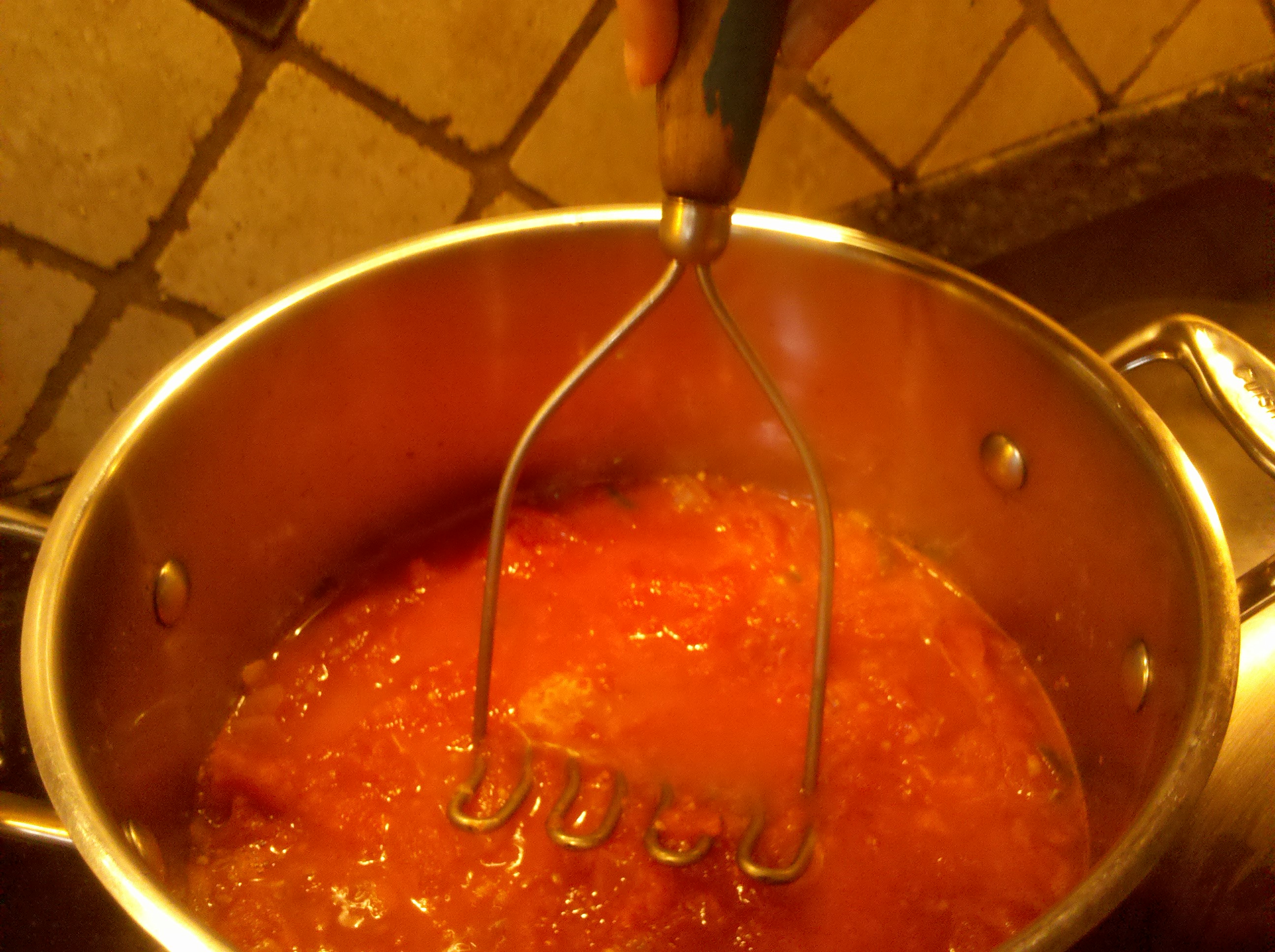
In a large stockpot, heat butter and olive oil over medium heat. Add shallot to soften for about two minutes. Add tomatoes, basil, garlic, tomatoes, wine, and sugar. Cover with lid ajar and simmer over low heat, about 30 minutes. With potato masher, break up tomatoes until well combined, and continue to simmer for at least another 10 minutes. Add salt to taste, being careful not to dump the whole container into your pot.

or

2 cans premium tomato sauce

Hurricane Irene Baked Penne with Sausage and Peppers

Ingredients:

Sauce of your choice, see above

1 package ziti or penne, cooked to al dente instructions

1 pound sausage, browned (I used hot Italian poultry sausage, Irene’s favorite)

1 onion, chopped

1 large pepper, chopped

Whole milk ricotta cheese, 15 oz.

2 cups shredded whole milk mozzarella

Directions:

Preheat oven to 375 degrees.

Brown sausage and add to sauce, simmering on low. In same skillet, saute onion and pepper, then add to sauce. Mix in ricotta cheese until well combined. Add 1 cup mozzarella, stir well, and then add pasta. All ingredients are now in one pot, see below.

Pour into a deep casserole dish or 13 x 9 glass pan, spread evenly, and top with one cup mozzarella. Bake for 30 minutes until brown and bubbly. Serve with red wine, unless you are worried that you will be without power for several days and want to save your wine for emergencies.